Introduction: Why detecting AI-generated content matters in 2026
By 2026, generative models write ads, summarize research, craft phishing emails, generate product images, and mimic voices at scale. For enterprises, educators, publishers, and platforms, knowing how to detect AI-generated content is no longer a niche skill—it’s an operational necessity. Detection underpins trust, compliance, revenue integrity, and brand safety across text, images, audio, and video.
Two realities define this moment. First, high-quality synthetic media is cheaper and faster than ever. Second, no single detector is accurate enough on its own. Organizations need an ensemble approach that combines provenance, stylometry, perplexity, watermark checks, and metadata forensics, governed by clear thresholds and human review. Done right, this yields a defensible, repeatable program that balances risk, fairness, and speed.
If your goal is to maintain editorial standards, enforce academic integrity, prevent fraud, or comply with emerging regulations, this guide lays out a pragmatic blueprint for detecting AI content in 2026—without over-claiming what the technology can do.
For broader content strategy context, see related resources on content operations and browse recent articles.
Quick Summary (TLDR): The fastest way to spot AI content
Short on time? Use this rapid, multi-signal workflow to triage suspicious content in minutes.
- Check provenance first: Verify a C2PA/Content Credentials manifest for images/video. If present and intact, treat the claim seriously.
- Run ensemble detectors: Use a text detector (stylometry + perplexity), an image deepfake model, or an audio spoof detector. Never trust a single score.
- Inspect metadata & file lineage: Look for EXIF/XMP edits, encoding anomalies, compression chains, and first-seen timestamps across the web. Cross-check with cryptographic hashes where applicable.
- Test fragility: Make targeted edits (reorder sentences, paraphrase a paragraph, slightly pitch-shift audio). AI text often exhibits brittle coherence and uniformity; real voices preserve idiosyncrasies post-edit.
- Apply policy thresholds: If risk ≥ your high threshold, escalate for human review; if between low–high, request more context; if low, accept with logging.
This process is fast, repeatable, and auditable—ideal for intake queues and frontline moderators learning how to detect AI-generated content without over-relying on any one tool.
Why Reliable Detection Is Hard: false positives, paraphrasing, and model drift
Accurate detection is difficult because modern models are trained on human data and optimized to imitate human style. That leads to overlapping distributions where statistical signatures of AI and human text are not perfectly separable. The result: false positives (human work flagged as AI) and false negatives (AI content passing as human).
- Paraphrasing and translation layers: Simple paraphrasers, chain-of-thought suppression, or translation can reduce detector confidence by masking stylometric and perplexity signals.
- Model drift: New releases change token preferences and rhythm, invalidating detectors tuned to older patterns. Detectors must be retrained and recalibrated frequently.
- Adversarial evasion: Attackers use prompt engineering, text noise, style transfer, or post-processing to bypass thresholds.
- Domain and language variance: Legal, medical, or multilingual content has unique structures; naive detectors misinterpret domain-specific patterns as synthetic.
- Data contamination: If a detector sees lots of human text with AI-like features (or vice versa), its boundary blurs.
Because of these factors, responsible programs treat scores as signals, not verdicts, and combine them with provenance, metadata, and human judgment.
Detection Methods That Work Together: stylometry, perplexity, watermark checks, provenance, and metadata
No single method is sufficient. A robust program uses complementary techniques and treats each as one part of a broader decision framework.
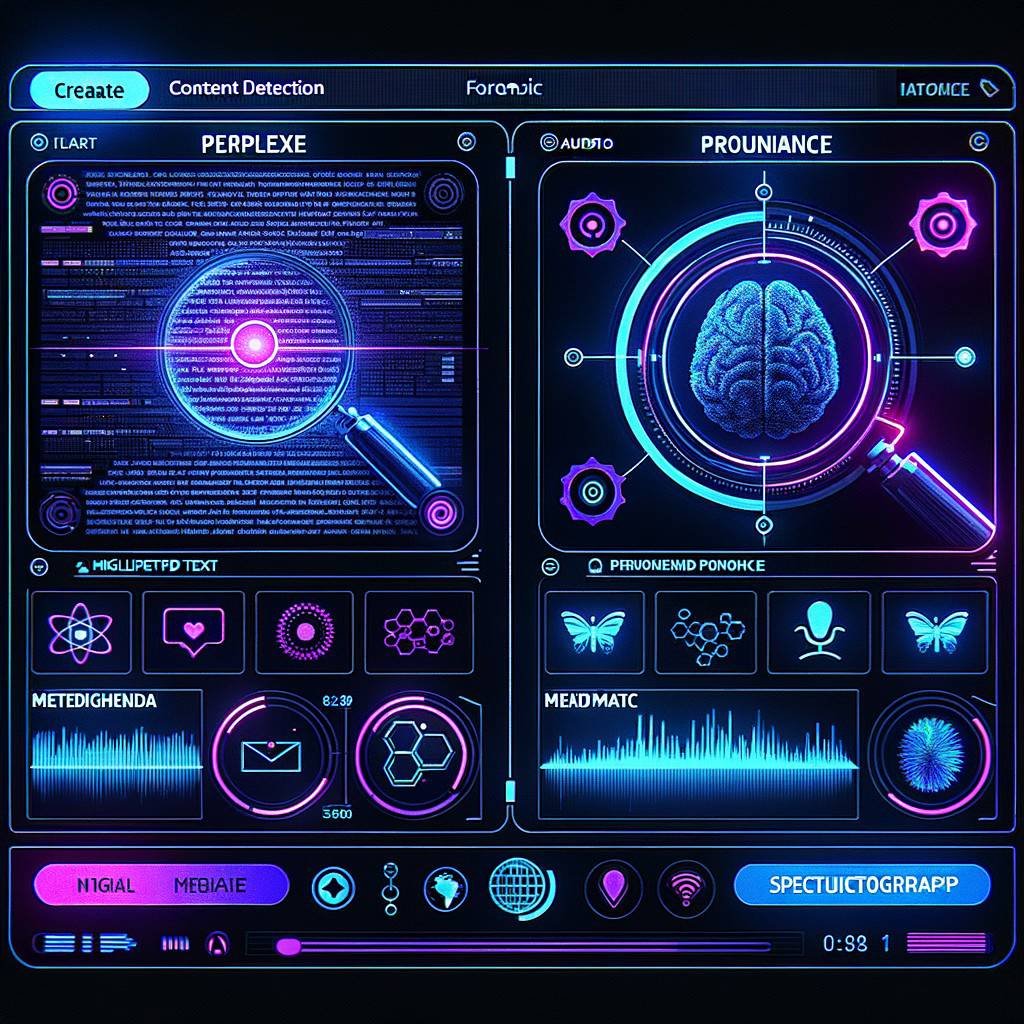
- Stylometry: Measures authorial features—sentence length variance, punctuation habits, lexical richness, and rhythm. See stylometry. Use it to compare a submission against a known-human writing baseline.
- Perplexity and burstiness: AI text often has smoother probability distributions. Track perplexity, burstiness, and entropy across paragraphs. Reference: perplexity in language modeling.
- Watermark checks: Some generators insert detectable patterns in token choices or pixel statistics. Watermarks can be removed or degraded, but still provide useful evidence when present. Background: digital watermarking.
- Provenance (C2PA/Content Credentials): Verifies the capture or edit chain using signed manifests. A valid manifest is strong evidence of origin; an absent one is not proof of deception. Explore C2PA and Content Credentials.
- Metadata forensics: Inspect EXIF/XMP for tool fingerprints, inconsistent time zones, and suspicious codec chains. Cross-verify with cryptographic hashes and first-seen crawls.
When these signals converge—e.g., low burstiness, inconsistent metadata, and missing provenance—the likelihood of synthetic origin increases. Your policy should require multiple independent indicators before taking consequential action.
Modality Playbooks: Text, image, audio, and video workflows
Different content types require distinct workflows. Use these playbooks to standardize how your team detects AI-generated content across modalities.
Text workflow
- Run ensemble detectors (stylometry + perplexity) and log scores with confidence intervals.
- Compare to a known-human baseline if available (e.g., prior writing samples for authors).
- Check for abnormal consistency: uniform sentence length, overly neat topic transitions, and low idiomatic variety.
- Perform fragility tests: reorder, compress, or paraphrase a section and see if coherence degrades unexpectedly.
- Escalate when multiple signals agree and the piece fails author verification or sourcing checks.
Image workflow
- Verify provenance via C2PA/Content Credentials if present.
- Scan EXIF/XMP: look for well-known generator tags, painting-like textures at micro-level, or out-of-lens artifacts.
- Use a deepfake/AI-image classifier as a signal, not a verdict. Check lighting and physics inconsistencies at edges.
- Cross-reference reverse image search for first-seen timestamps and duplicates.
Audio workflow
- Run a spoofing/voice cloning detector; examine spectrograms for formant and prosody anomalies.
- Check microphone and room-tone consistency; cloned voices often lack natural micro-variations.
- Validate speaker identity and consent for high-stakes use cases (e.g., finance, customer support).
Video workflow
- Verify frame-level provenance; scan for face-warping at transitions and blink patterns typical of deepfakes. See deepfakes.
- Analyze audio-video sync and compression chains; mismatches raise risk.
- For UGC platforms, combine device fingerprinting and account signals with media analysis for a stronger verdict.
For a broader content governance lens, you can also review evolving best practices in marketing ops and analytics on my site.
Implementation Blueprint: tool stack, thresholds, human review, and documentation
A defensible detection program is as much about process as it is about models. Build a repeatable pipeline with policy-driven thresholds and strong documentation.
Tool stack
- Ingest: Content gateway that normalizes inputs and computes cryptographic hashes.
- Provenance: C2PA/Content Credentials verifier, plus reverse image/video search.
- Detectors: Text (stylometry + perplexity), image deepfake classifier, audio spoof detector, video frame anomaly detector.
- Forensics: EXIF/XMP reader, codec chain analyzer, and first-seen web crawler.
- Evidence store: Append-only logs, immutable storage for artifacts and scores.
Risk thresholds
- Define low, medium, and high risk bands per modality with review SLAs (e.g., high-risk content reviewed within 24 hours).
- Use confidence intervals—not just point estimates—and require agreement from two or more independent signals before escalation.
- Tune thresholds by business unit; legal content and healthcare require tighter tolerances than casual blog posts.
Human-in-the-loop
- Route high and ambiguous cases to trained reviewers with a standardized rubric.
- Require author verification for disputed cases (e.g., prior work samples, edit history).
- Protect against reviewer bias with blind evaluations and inter-rater agreement checks.
Documentation and auditability
- Version every model and configuration; track when and why thresholds change.
- Log inputs, scores, rationales, and outcomes for each decision.
- Perform quarterly calibration using holdout sets and adversarial red-teaming.
For governance alignment, consider the NIST AI Risk Management Framework and clearly document how your approach mitigates risks and supports due process.
Risks, Ethics, and Legal: consent, bias, due process, and disclosure policies
Detection can impact livelihoods and reputations. Treat it as a sensitive risk practice with explicit safeguards.
- Consent and privacy: Inform users that you perform authenticity checks and what data is processed (metadata, audio features, etc.). Store only what you need, for as long as needed.
- Bias and fairness: Detectors can misfire on non-native writing or dialects. Regularly test across languages and demographics; measure false positive rates by cohort.
- Due process: Avoid automated penalties. Provide notice, evidence summaries, and an appeal path. Document reviewer decisions and allow authors to supply provenance.
- Disclosure policies: Require labeling of synthetic content where material. Align with platform rules and consumer protection guidance (see the FTC on AI claims).
- Regulatory alignment: Track emerging requirements such as the EU’s AI Act for transparency and risk management.
- Copyright and takedowns: Retain hashes and logs to support DMCA processes; see the DMCA overview.
Ethical detection programs are transparent, minimally intrusive, and offer redress. That protects users, reduces legal exposure, and preserves trust.
Conclusion: Build a robust, defensible detection program
Knowing how to detect AI-generated content in 2026 is about orchestration, not magic bullets. Combine provenance, stylometry, perplexity, watermark checks, and metadata forensics. Calibrate thresholds, route ambiguous cases to trained reviewers, and document every decision.
Organizations that treat detection as part of a broader content governance system—policy, process, and people—gain resilience against fraud, misinformation, and brand risk. Start small with a pilot, measure outcomes, and expand coverage by modality and market.
As models evolve, your detection program should evolve, too. With an ensemble approach and rigorous operations, you can move fast while staying fair and defensible.
FAQ: Frequently asked questions on AI content detection
Can detectors prove with certainty that content is AI-generated?
No. Detectors provide probabilistic signals. Treat results as evidence to be combined with provenance, metadata, and human review—not as courtroom-proof.
What’s the single best signal?
A valid, intact C2PA/Content Credentials manifest is the strongest positive signal of origin for images and video. For text, convergence of stylometry and perplexity with author mismatch is compelling.
Do paraphrasers defeat detection?
They can lower confidence in stylometric and perplexity signals, but often leave traces (semantic repetition, inconsistent tone). Combine multiple detectors and metadata checks to compensate.
How do I set thresholds?
Run a calibration study on your own content: label a holdout set of human and synthetic samples, sweep thresholds, and pick operating points that minimize harmful false positives for your use case.
What about multilingual content?
Use language-specific baselines and detectors trained on the target language. Avoid applying English-tuned models to other languages without validation.
Can I detect AI images reliably?
Reliability increases when you combine provenance verification, metadata forensics, and a modern AI-image classifier. Absence of provenance is not proof; look for converging anomalies.
How do I detect cloned voices?
Use spoofing detectors that analyze spectral features and prosody. Check channel consistency (mic/room). For sensitive workflows, require verified speaker enrollment and consent.
Is it legal to scan user uploads?
Generally yes with clear terms, consent, and privacy safeguards. Follow consumer protection guidance and emerging regulations, and provide an appeal process for adverse decisions.
Will detectors keep up with new models?
Only if you plan for model drift. Retrain and recalibrate quarterly, monitor performance by segment, and maintain a red-team program to test evasions.
Where can I learn more?
Review C2PA, Content Credentials, stylometry, and the NIST AI RMF. For marketing and analytics applications, explore additional insights on my site.