
Introduction
For decades, quantum gravity— the quest to unite General Relativity with Quantum Mechanics— lived chiefly in the realm of thought experiments and high‑energy cosmology. Recent advances in quantum sensing, optomechanics, and ultra‑precise metrology have opened a surprising new frontier: tabletop‑scale experiments that probe the very structure of spacetime with energies far below the Planck scale. This article surveys the most promising laboratory approaches, explains what they’re testing, and highlights why they matter for our understanding of the universe.
1. Why Tabletop?
The Planck energy (~10¹⁹ GeV) is utterly inaccessible to particle accelerators. Yet many theories of quantum gravity predict tiny deviations from standard physics that accumulate over macroscopic distances or times, making them detectable with exquisitely sensitive lab apparatus. Key advantages include:
– Controlled environments – Vibration isolation, magnetic shielding, and cryogenic platforms reduce noise to unprecedented levels.
– Repeatability – Experiments can be run many times, allowing statistical precision that astrophysical observations often lack.
– Flexibility – Researchers can swiftly modify parameters (mass, separation, laser wavelength) to test multiple theoretical signatures.
2. Core Experimental Strategies
Optomechanical resonators
The optomechanical resonator approach serves as a high-precision method for probing potential deviations from the inverse-square law at micrometer scales, as well as searching for indications of spatial discreteness. In a typical experimental setup, a microscopic mirror or membrane is integrated into a high-finesse optical cavity where laser interferometry is used to measure position with extreme precision. These systems are designed with an ambitious sensitivity goal, targeting a force resolution on the order of $10-18 N to detect even the subtlest gravitational anomalies.
Atom interferometry

Atom interferometry serves as a high-precision probe for fundamental physics, specifically targeting potential violations of the equivalence principle and phase noise induced by the granular nature of “spacetime foam.” In a typical experimental setup, cold-atom clouds are launched within a vertical interferometer, utilizing laser pulses to act as atomic beam splitters that manipulate the wave nature of the atoms. To achieve its scientific objectives, the system targets a sensitivity goal where phase noise is maintained at less than <10⁻⁶ rad/√Hz, providing a rigorous testing ground for our understanding of gravity and quantum mechanics.
Torsion balances & Cavendish‑type experiments
Torsion balances and Cavendish-type experiments act as the ultra-sensitive “bloodhounds” of the physics world, primarily designed to probe for exotic spin-dependent forces, extra dimensions, or Lorentz-violating backgrounds. To catch these faint signals, a typical setup employs a rotating pendulum integrated with test masses, where even the most microscopic displacements are captured via optical levers or capacitive readouts. The technical “holy grail” for these experiments is achieving a torque sensitivity in the realm of 10⁻¹⁶ Nm, a level of precision necessary to detect interactions that would otherwise be lost in the background noise of the universe.
Superconducting circuits & Josephson junctions
Superconducting circuits and Josephson junctions serve as high-precision tools designed to probe graviton-like excitations and potential modifications to the photon dispersion relation. To achieve this, a typical experimental setup employs microwave resonators cooled to millikelvin temperatures—chillier than deep space—to enable sophisticated single-photon detection. The primary sensitivity target for these configurations is an incredibly fine energy resolution of approximately 10⁻²⁴ J, ensuring that even the most subtle quantum signatures can be captured.
Macroscopic quantum superpositions (e.g., levitated nanospheres)
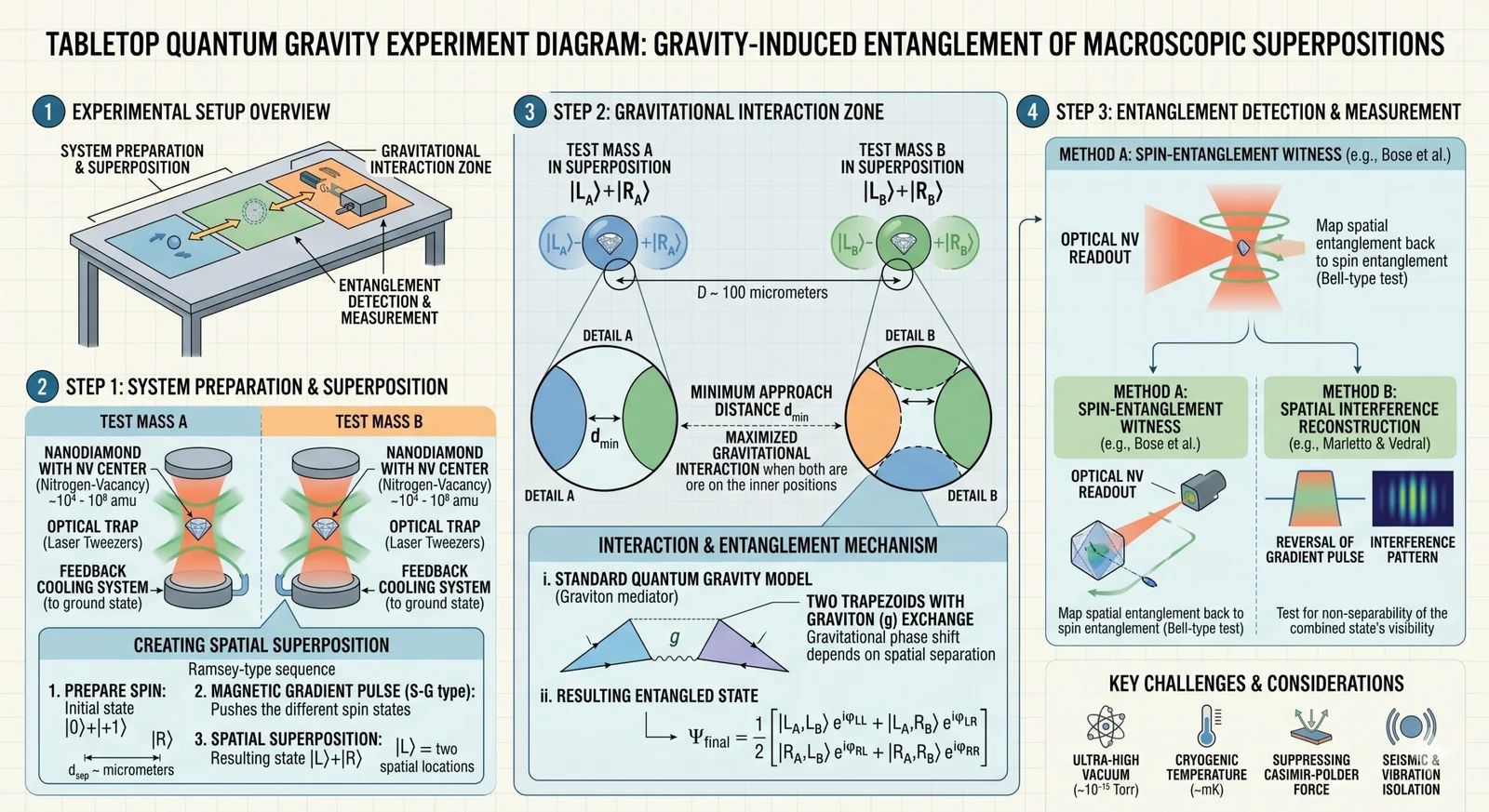
Research into macroscopic quantum superpositions, particularly using levitated nanospheres, serves as a critical testbed for determining if gravity induces wavefunction collapse, as suggested by models like the Diosi-Penrose theory. These experiments generally utilize dielectric nanoparticles maintained in a state of optical or electrostatic levitation, where quantum interference is achieved via precisely timed pulsed gradients. To effectively observe these phenomena and challenge current theoretical limits, the experimental setups target a high degree of sensitivity, aiming for a collapse rate of approximately 10⁻¹⁶ s⁻¹.
3. Signature Effects Being Hunted
– Modified dispersion relations: If spacetime has a granular structure, photons of different frequencies may travel at slightly different speeds— detectable as a frequency‑dependent phase shift in interferometers.
– Spacetime foam noise: Random fluctuations in the metric could manifest as an extra phase diffusion in atom interferometers, akin to “gravitational shot noise.”
– Violations of the equivalence principle: Differential acceleration of different materials or spin states would signal new couplings to gravity.
– Non‑Newtonian gravity at short ranges: Extra dimensions or scalar fields could strengthen or weaken gravity below ~10 µm, detectable via force sensitivities beyond the Casimir background.
4. Recent Milestones
– 2023: A levitated‑nanosphere experiment placed an upper bound on the Diosi‑Penrose collapse rate of ~10⁻¹⁶ s⁻¹, approaching the parameter space where gravity‑induced collapse could be tested.
– 2024: An atom‑interferometer test of the equivalence principle reached a differential acceleration sensitivity of 10⁻¹⁵ g, constraining certain string‑theory motivated dilaton scenarios.
– 2025: A cryogenic optomechanical resonator measured forces at 10⁻¹⁸ N, narrowing the allowed parameter space for Yukawa‑type corrections to Newtonian gravity in the 1–10 µm range.
5. Challenges & Mitigations
– Seismic & thermal noise: Overcome with multi‑stage vibration isolation, active feedback control, and operation at millikelvin temperatures.
– Casimir & patch potentials: Careful material selection, surface cleaning, and theoretical modeling subtract these backgrounds from force measurements.
– Electromagnetic interference: Magnetic shielding, superconducting shields, and synchronous detection techniques isolate genuine gravitational signals.
– Theory‑experiment gap: Close collaboration between phenomenologists (who translate quantum‑gravity models into observable signatures) and experimentalists ensures that searches are targeted and interpretable.
6. The Road Ahead
Looking forward, the community aims to:
– Push force sensitivity below 10⁻²⁰ N using levitated superconducting sensors, probing the predicted range of certain asymptotically safe gravity scenarios.
– Entangle massive objects (e.g., two 10⁻¹⁴ g crystals) to test whether gravitation can entangle quantum states—a direct probe of gravity’s quantum nature.
– Network multiple tabletop sensors globally to look for correlated bursts that could signal passing gravitational waves or exotic topological defects.
7. Why It Matters
Confirming—or ruling out—any of these tiny deviations would dramatically reshape our understanding of spacetime. A positive signal would provide the first empirical clue to the quantum structure of gravity, guiding theories toward a unified framework. A null result, meanwhile, tightens constraints on speculative models, helping theorists focus on the most promising avenues. Either outcome moves us beyond reliance on ultra‑high‑energy collisions or astrophysical extremes and brings quantum gravity into the realm of controllable, repeatable laboratory science.
Conclusion
The era of tabletop quantum‑gravity experiments is here. By harnessing cutting‑edge quantum sensors, ultralow‑noise environments, and clever interferometric designs, physicists are now able to test the fabric of spacetime with unprecedented precision. While we have not yet heard the definitive “tick” of quantum spacetime, each new bound narrows the possibilities and brings us closer to answering one of the deepest questions in physics: How does gravity behave at the quantum level? The answers, it seems, may soon emerge not from distant galaxies or colossal colliders, but from a quiet bench-top lab, where a laser, a mirror, and a nanoparticle conspire to whisper the secrets of the universe.